



It's not just the language David Lagercrantz uses in his writing. Equally important
the acting and music have significance. The courage to take on others' burdens as well as one's own
Stories and contemporary reflections are self-evident parts of his success concept.
PHOTO KAJSA GÖRANSSON
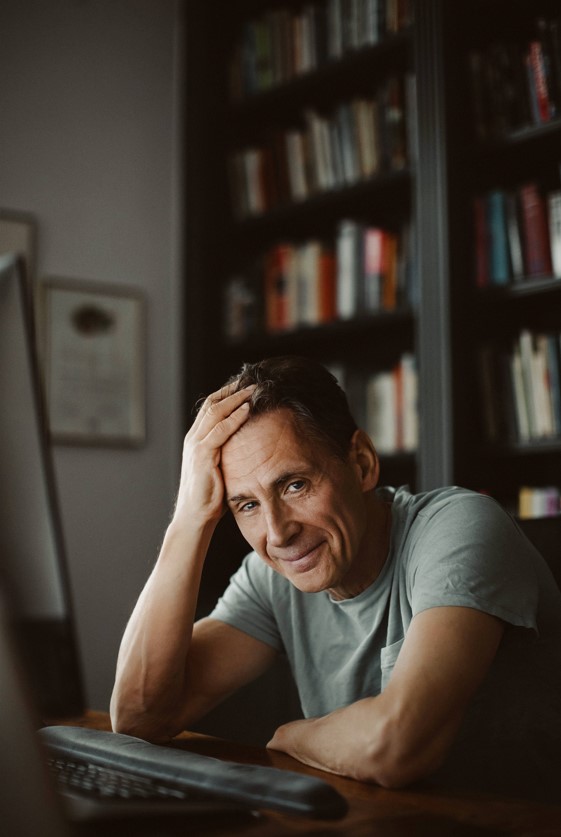
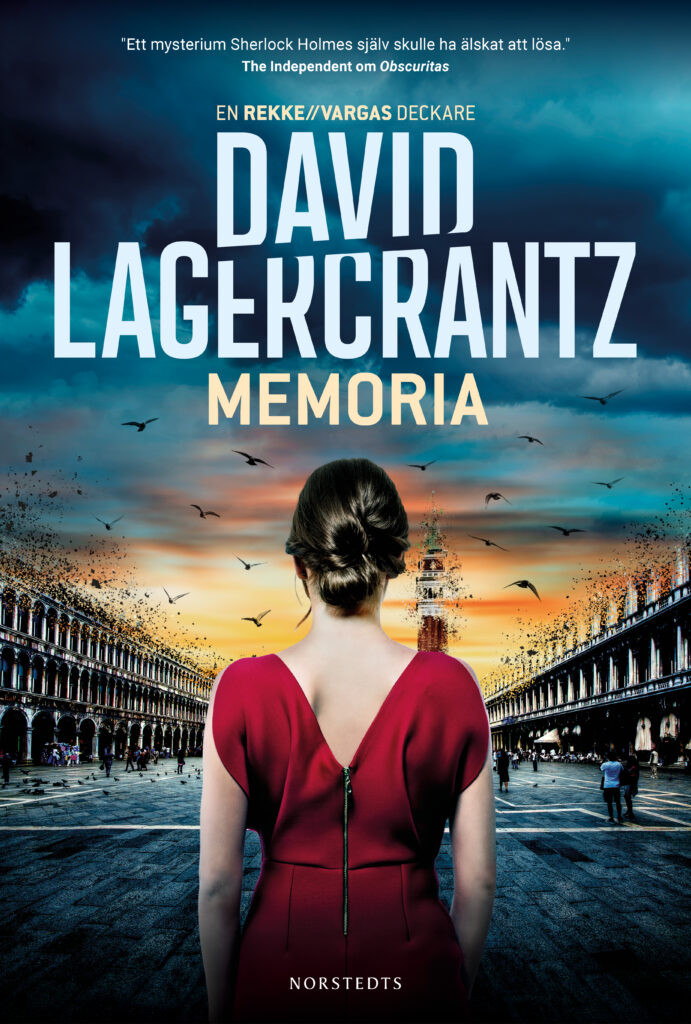
David Lagercrantz is one of Sweden's most successful authors. I Am Zlatan is one of the best-selling books ever in Sweden and the one the author himself is most proud of, as it inspired a whole new audience to read books. Almost ten years ago, he took on Stieg Larsson's mantle as the author of the books in the Millennium series. The Girl Who Dared, The Girl Who Takes an Eye for an Eye, and The Girl Who Lived Twice made David Lagercrantz a critically acclaimed and award-winning global celebrity. In 2021 came Obscuritas, the highly anticipated first instalment in David Lagercrantz's new detective series about Professor Hans Rekke and police assistant Michaela Vargas. It was hailed by critics and loved by readers. He is now releasing
Part two, Memoria. INRIKES magazine meets David Lagercrantz via Zoom. It takes a couple of minutes
before we get settled. The Zoom link only works on the third attempt. Behind him, a gigantic bookcase is visible, crammed full of books. Just as he's settled down, his wife calls him on his mobile from New York. He silences the ring and texts her to let her know he's in an interview. His hair is
His hair is a bit messy, his shirt is unbuttoned incorrectly and his reading glasses are stubbornly sliding down his nose as he fiddles with his phone. At the same time, he accidentally hits some button on the computer keyboard, making the screen go black. A second later, the image returns. He laughs, tidies his hair, fastens the last shirt button and looks up at the screen with a broad smile.
Right then! Now we can get started.
I am a neurotic person who is constantly dissatisfied and thinks I am hopeless and incapable.
and won't manage, but it creates a drive that makes me push myself.
I'm on the second to last chapter of your current book Memoria. It's an incredibly good story and I love it
Your drive. It just keeps pouring on, you can't stop reading!
– Thank you. I put a lot of work into the language. I take great pleasure in creating; I do a lot of editing. I’ve worked on this as I’ve developed my own style. I want it to sound a bit like music and flow naturally; that’s how I try to write, at any rate.
I like your way of stepping into the different characters, especially how you can think like a young woman. How have you found your rich knowledge of people?
– I am trying to live and I think when I am about to enter someone who is different from myself, there is something of oneself in all destinies. You can then take, for example, the girl Michaela Vargas who is my hero in Memoria. She grew up in Husby and that is certainly not me. But like Michaela, I have felt
out. I have felt like an outsider and I have felt a longing to belong. Then you have to take care of those feelings and reinforce them when you write. If you're going to dedicate yourself to being a writer, you just have to be curious, you have to talk to people. So I do that all the time, I soak up information.
Do you think we humans are pretty similar at our core?
– Yes, I think it's quite nice that we're not that different, just different feelings. Even if you're going to write about a bad person, you can bring out the worst in yourself and think about it. I often find that the more you write about a person, the more you get to know them.
Does it feel like acting when you write, that you step into different roles when you write stories from different perspectives?
A person's perspective?
– Yes, I think so. It's always been my trick. I have to feel like her or him. I've always loved theatre, it was my first great love and my first talent too. When I got into writing, I ghost-wrote books and it was an exciting experience because then I had to get into it. ‘I am Zlatan!’ I often told myself when I was writing as Zlatan. It was important to get into that role because
Otherwise I wouldn't have been able to do it.
You write novels and evening newspaper columns that are published in various types of media for different reader demographics. Can you work on different types of projects simultaneously, or do you go ‘all in’ on one thing at a time?
– I’m having a rather nice week. I’m currently writing the third part of the detective series about Professor Hans Rekke and Police Assistant Michaela Vargas, and I’m doing that on Monday, Tuesday, and Wednesday. When Thursday comes, I take a break and write a column. It’s quite pleasant. Partly because it’s a slightly different format, and it gets me going. If things haven’t gone well with the novel this week, I can pick it up again next week or next month. You can postpone writing novels, and that can lead to a certain slowness, but when
I write columns so I know that I have to deliver by a certain time. That's quite nice, especially when you're an old journalist.
Deadlines are a must in life. Nothing would get done without deadlines.
– No, one wouldn't survive. Book deadlines are quite far off, but there's something magical when deadlines start to approach. I like it, I think it's good for creativity to be forced to deliver. If you have a long time, you risk delaying yourself and becoming a bit lazy. I believe in the idea of pace. Novels exist in a kind of timeless universe, while it's wonderful to step into the present when writing columns, to immerse yourself in current issues, especially when the world is so terribly troubled.
When did you discover you were good at expressing yourself in writing?
I don't know. I grew up in a writer's home, so I suppose I got it with my mother's milk.
Somehow. Sometimes I think I wanted to be an author before I wanted to write, because for me, an author was someone who was painted as the ideal. I had some problems with writing because I have some dyslexic tendencies. I had to struggle a lot and got bad marks on what I wrote at first because there were so many spelling mistakes and skipped words. But I usually say it's a superpower because it made me understand from the beginning that writing is a struggle. I had to make an effort. Many who found it easy relaxed, but I kept sitting and struggling and knew that this is difficult and it slowly, slowly yielded results.
Could it be a good thing that things aren't too easy at the start, so that one is forced to struggle and be self-critical and never completely satisfied with what one does?
– Yes, because something is always happening. Otherwise, there's a risk you'll stagnate. You can't be satisfied. Being satisfied is life-threatening; pride leads to ruin. I'm a neurotic person who is constantly dissatisfied and thinks I'm hopeless and won't manage and won't finish in time, but that creates a drive that makes me exert myself.
In previous interviews, you've spoken openly about your depression. Do you find it easier now to talk about things that were once almost taboo?
– It used to be very stigmatised. It's a wonderful thing that we can talk about it, even if it can sometimes get a bit much. For example, we suddenly see famous people using it as part of their career path to talk about interesting diagnoses. I believe, and have always believed my whole life, that if you're going to have a good conversation, you need to have transparency and be sincere. I also believe that if I talk about
that I've had a tough time, people can find comfort in that.
Absolutely. We probably all feel that ‘no one understands me’ sometimes. As you said earlier, we're not that different from each other, deep down.
It's wonderful and one should try to approach it. Try to get to the heart of the matter, immediately. The good thing about literature is that you can read about people, that you understand that we are not alone.
Being the child of successful parents can be very difficult in various ways and that's something you've spoken about over the years, how your father Olof, who was successful journalist and editor, was very harsh on you. What lessons can you take from his mistakes and what do you do to avoid repeating it to your children?
You try not to repeat your parents' mistakes. They were wonderful in many ways, but there was a feeling that you only received true love through achievement. Even if it wasn't said, I could feel it when you showed signs of talent. There's something unsettling about that, if a child doesn't feel that they're not achieving, that they're not loved. It can lead to deep wounds. I'm constantly trying to think about that and
Just encourage my children.
Now that you're successful, winning nice awards and getting fantastic reviews, does it ever occur to you, ‘Dad would have read this!!’?’
– Yes, of course. You never get rid of your father, especially not if, like me, you had a strong father who was a powerhouse. It happens that I think of him and it happens that I unconsciously try to become a little like him. It can be both funny and uncomfortable. He was such a publicist, so now when I write columns, it’s clear that Olof is haunting somewhere, ‘now I’m going to show him that I’m just as good.,
preferably better.
When writing, you can be driven by a certain feeling of revenge, wanting certain people to read your text and your byline.
– Yes, I've felt that way too. ‘Now watch what I can do, you bastards!’ Especially if it's the sort of people who have looked down on you and said contemptuous things. You can really be crushed when people are judgmental, but it can also be a spur. I had a teacher at the Journalism College who told me I should take up knitting or lacemaking, but definitely not writing. I'll never forget that!
Good heavens, what incredible influence a teacher can have. You're not supposed to say that to a pupil.
– You don't do that! I think that's something to consider. Before you say something harsh to another person, you should think about how you yourself would have experienced it.
I am very committed to encouraging more people to read books. Let me tell you about it.
– I'm working with an organisation called The Reading Movement. I became very engaged when I was writing the book *I Am Zlatan*. When I was writing the book, I didn't really know who I was writing for, so it was a shock when I had my first author talks about the book and guys who looked like criminals, who had never been to a library, never been inside a bookshop, turned up. That’s when I understood that I
suddenly reached a whole new generation.
It must be a fantastic feeling to write a book that reaches so widely and broadly across different target audiences worldwide.
– Yes. I think one should try to find books that speak to you. You have to find somewhere there's a passion. Today, I think it's more important than ever. When *I Am Zlatan* came out in 2011, digital media was taking over. I believe it's a serious societal problem that so few people read. I'm biased, of course, because I write books, but books offer a longer perspective and can actually make you see the world in a new way and understand that someone who is actually a stranger can actually be seen as yourself. That's actually quite cool.
How do you capture a reader today, in competition with mobile phones and all the fast digital media?
You have to grab the reader quickly; it's not enough to start a book with ‘The Wind in the Willows’, you have to get in – straight away. It's a challenge to capture the reader, and it's very enjoyable when you succeed. What are you most proud of in your career?.
I'm pleased that I'm improving and I think it's great, even though I'm incredibly tired of the Zlatan book because I've been talking about it for twelve years, I'm proud to be able to reach people who otherwise don't read. It was such a significant thing for me coming from an intellectual home where you were always supposed to write for the Parnassus and the fine culture pages. I succeeded in being seen by the culture pages yet still reaching a completely different target audience.
The Millennium books must make you incredibly proud also. What an enormous – and risky – project to undertake.
– I’m also proud that I managed the Millennium project, that I survived it. There was such terrible anger, you shouldn't behave like that and I was a Lagercrantz and everyone was against me and a whole world wanted to stab me in the back. I lay there trembling and everyone was after me. Haha! But I survived.
Do you have any side hustles, run a business, manage wealth, or anything else?
– No, my God. I have my three children and I have what comes with the books, interviews and that sort of thing. I try to read and I seriously try to understand the world. I put quite a bit of energy into that. Every morning I get up and read the Washington Post, the New Yorker, and I always did that because it feels so incredibly important to understand what's going on, what's happening. Now that I write columns I
It has enriched me. I look after my family and write columns, books and do interviews and things like that. I think that's enough.
So… you have no ambitions to start a clothing brand or perfume line?
No, for God's sake! Everyone can do as they please. But I belong to a generation where you shouldn't sell yourself out, and I think it's quite important that if you're going to be an intellectual, you should be free. You shouldn't have a lot of secret loyalties to companies. I think there's a pretty nasty influencer culture where people let themselves be bought. Especially when the world is so rotten in so many ways, you have to be careful.
I had a teacher at the School of Journalism who told me I should take up knitting or bobbin lace, but hell no writing. I'll never forget that!
Do you watch a lot of films and TV??
– I watch documentaries. I constantly want to educate myself. I really enjoy Anders Hansen's programmes. I recently took part in an episode of his latest series, Min personlighet, on SVT. I dream of educating the public, of teaching complicated things in a simple way. That's where I think Anders Hansen
is completely exemplary. It is a wonderful gift to be able to talk about scientific matters. I am very interested in popular science and I try to sneak that into my books. When things are exciting in a book, we are more likely to listen, and it's a pedagogical trick one would want to use more.
Are you listening to music?
– Thanks to my son, I listen to classical music. I listen a lot to Schubert, Liszt, and Beethoven. When the world looks the way it does, music is the antithesis of all the evil and aggression that exists. Music is something that can unite us and make us feel a reverence for life. Music is like the opposite of everything; there's something beautiful, something grand in it. I also notice this when I write, that music is entering my books more and more, and I'm beginning to see prose more like music when I write. Most of all, I want my texts to sing like beautiful melodies.
FAVOURITE SPOTS IN STOCKHOLM
Djurgården. I live very close by and I run there almost every day. I don't listen to any podcasts, I don't have my phone on. I let my thoughts wander. I daydream, it's significant and afterwards I feel cleansed.
My neighbourhood in Östermalm. I'm trying to create my world there. I have my favourite restaurant around the corner. I eat lunch locally and go for little walks to the shop. I grew up at Drottningholm, on the other side of the castle. I sometimes travel there for a walk. It's nice.
DAVID LAGERCRANTZ
Age: 61.
Occupation Author and columnist for Expressen.
Family Wife Anne Lagercrantz, head of SVT. Children Signe, Nelly and Hjalmar.
Bor Östermalm, Stockholm. Background in brief: Studied at the School of Journalism in Gothenburg. Worked as a crime reporter during the 80s. Made his debut as an author in 1997 with the story of the adventurer Göran Kropp. The breakthrough in fiction came with "Syndafall i Wilmslow" (Fallen Angels in Wilmslow). "I Am Zlatan" is one of the best-selling books ever in Sweden. Almost ten years ago, he took on Stieg Larsson's mantle as the author of the Millennium series books. What Doesn't Kill Us, The Man Who Searched for His Shadow, and She Who Must Die. 2021 came Darkness. Currently The novel Memoria, which is the second part in the detective series about Professor Hans Rekke and police assistant Michaela Vargas. Favourite authors during childhood: “When I was young, I read tough guys like Hemingway, and then early on I discovered Knut Hamsun's writings from when he was young and it ignited a fever in me. It made me start writing. I was so incredibly inspired. Then I started reading the Russian authors, Dostoevsky, and there was an enormous narrative drive. Albert Camus was a great hero, of course. I read constantly and changed my favourites. Gabriel García Márquez is another genre, he mixed different time perspectives, and it was brilliant. It's a good way to learn to write, by trying to imitate the great masters. Hjalmar Söderberg was my hero too, I try to write with a clarified musicality.”