
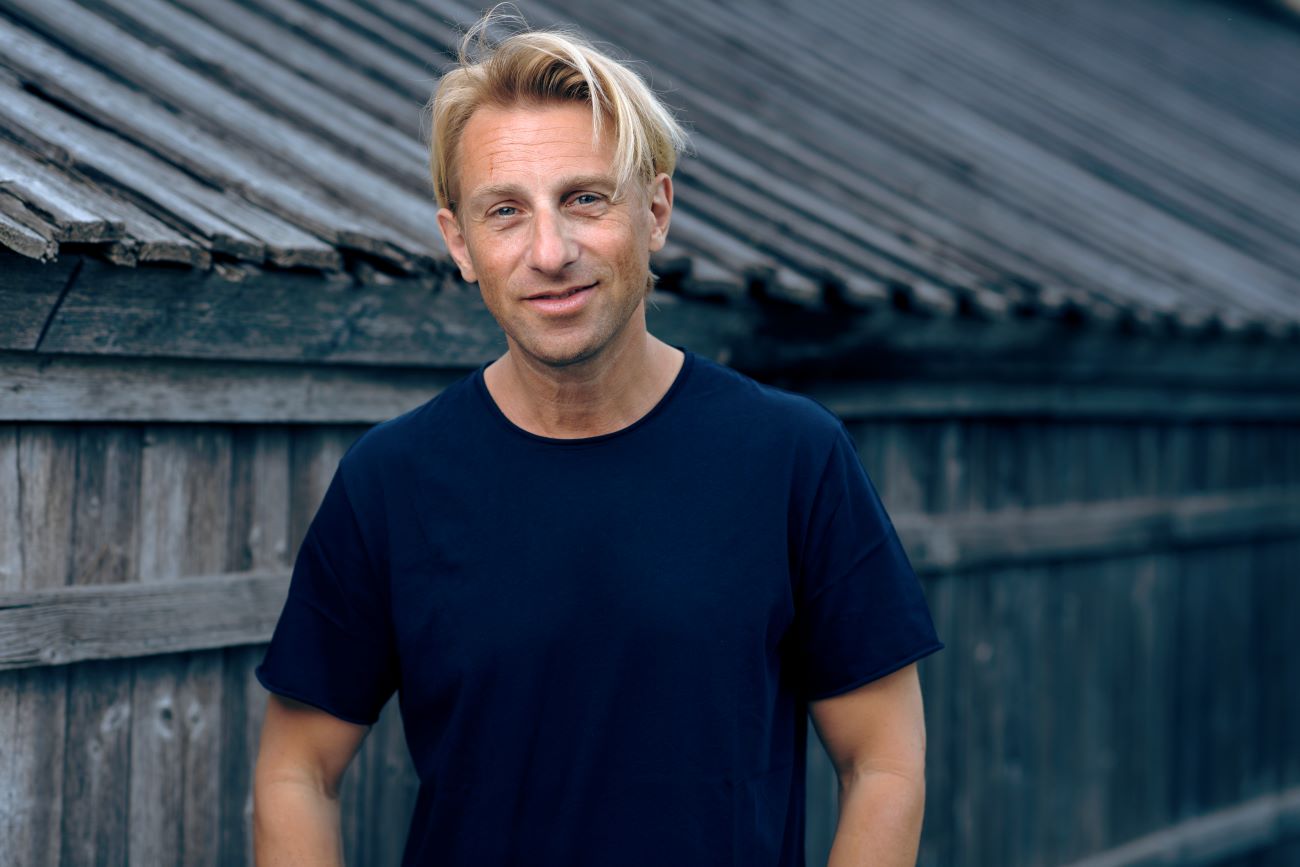
Explaining the complex in a simple way is one of the superpowers Anders Hansen possesses. The brain is still the focus, but now it's being challenged by AI. Who inspires him and why he makes sure to run almost daily has an absolutely simple explanation.
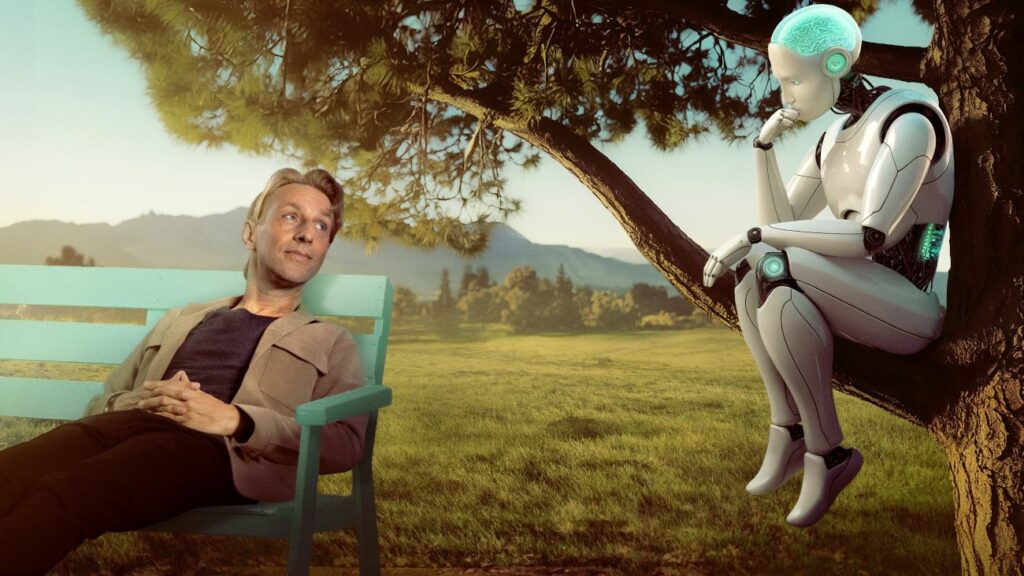
AI is, for better or worse, more powerful than any other technology, and if we are to navigate this, we must understand ourselves better. We must learn to understand our Achilles' heels.
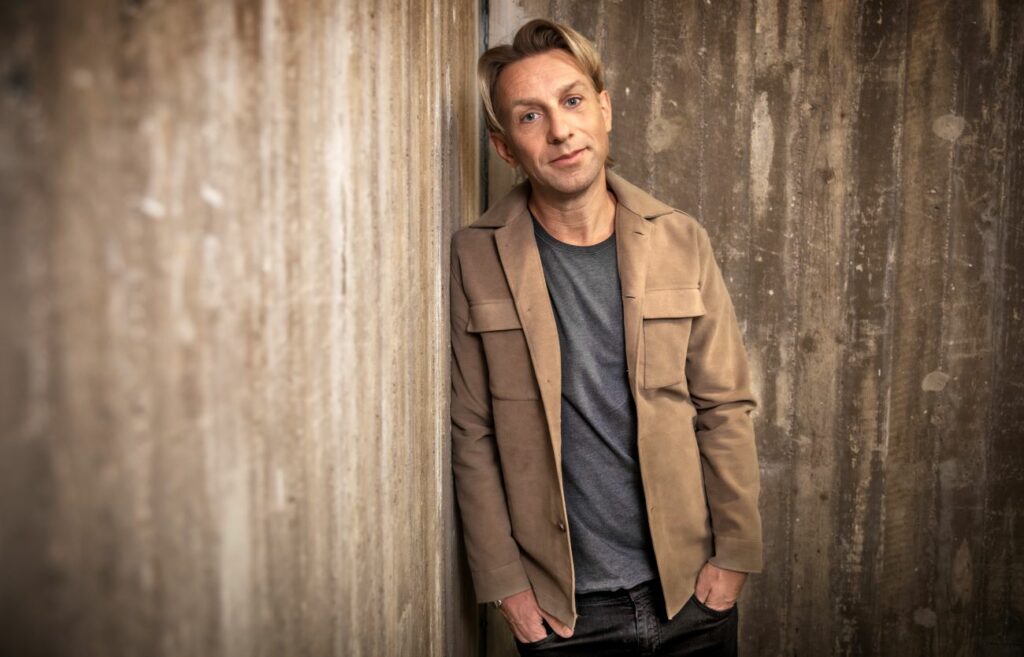
Anders Hansen is punctual. Exactly on the agreed time, there's a chime on Zoom and the cheerful face from TV pops up on the screen. The psychiatrist, author and presenter has a curious and open attitude that we recognise from his popular TV programmes. In four episodes of "Smarter than the Brain" – which is currently available on SVT Play – Anders investigates and compares AI with our own brains, as well as considering AI's opportunities and dangers.
Anders Hansen has a burning interest in general knowledge that shines through in his programmes. He has succeeded in creating TV programmes about science and technology that appeal to a broad audience. However, it is no easy task to explain what AI (Artificial intelligence) is and how it affects our brains in a way that appeals to TV viewers of all ages.
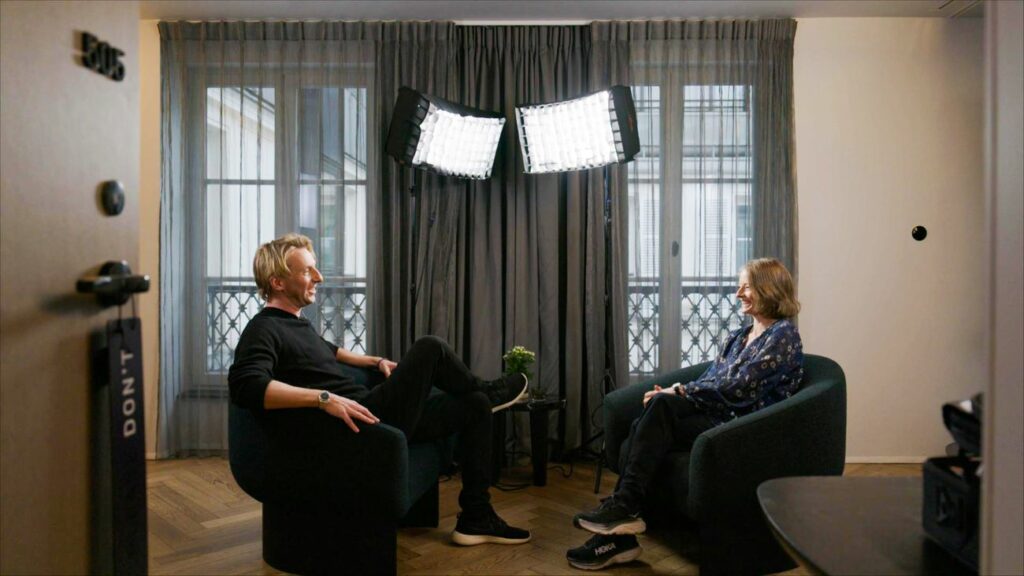
“When I started thinking about the series, I didn’t want to make a series about technology but about how people function,” says Anders, who is smiling as he sits in front of his computer screen. His hair is a bit dishevelled and he’s wearing a grey t-shirt. The bright room behind him has white-painted walls adorned with a few framed black-and-white photographs. A beautiful chandelier hangs from the ceiling.
– We need to know more than ever how the human brain works, says Anders. AI technology can be both the best thing that has happened and the worst thing that has happened. To quote a historian, ‘a knife is a tool that you can use to cut salad with or save people's lives with, or you can stab someone to death’. Anders explains that AI is more powerful than a knife and therefore can be used for more fantastic and terrible things. And unlike a knife, AI is constantly developing. AI is changing and becoming smarter all the time.
– AI is, for better or worse, more powerful than any other technology, and if we want to be able to navigate this, we need to understand ourselves better. We need to learn to understand our Achilles' heels.
Anders adds that AI might mean that such a significant change occurs that
it is on a par with the industrial revolution.
– I think a lot of people feel left out, don’t understand what this is. I wanted those who didn’t understand a thing about AI and weren’t interested at all to still get a little insight. When my mother, who is completely uninterested in technology, saw the episodes, she said, ‘now I understand a bit’ and then she told her friends and then she no longer felt left out. She’s part of societal change, and that was one reason why I wanted to make this series – so that more people would feel included in the AI development.
What makes many of us afraid of AI's advancement may be partly due to us daily reading and hearing about various examples where AI has been used by fraudsters to access our bank accounts or steal our identities, not to mention disinformation and fake images and videos in the media – and a lot of other things that create confusion and worry. Soon we won't know what to believe anymore.
– Disinformation and deep fakes, these are things we encounter daily already, and that's why it's important that we understand how we can be tricked so that we don't get tricked, says Anders. Therefore, it's important that this knowledge is disseminated as quickly as possible. If you understand your brain and yourself better, you will also start to take
other decisions. Changing our behaviour isn't something that happens overnight, but according to Anders it's possible.
– if we just want to.
But it won't arrive like a letter in the post straight away. It requires hearing it many times so that it really sinks in, and eventually, you'll see it unfold within yourself. And then you'll change things in your life. That's my experience, and it applies regardless of whether you're talking about decisions concerning exercise, sleep, and genuine connection. We need to understand how our instincts, which once evolved to help us survive, risk leading us astray in today's society. It will be
more important than ever in a world with AI.
When Anders and the rest of the production team are working on TV programmes such as *Smarter than the Brain*, they spend a great deal of time finding ways to explain things in a way that really gets the message across. He explains that he puts an enormous amount of effort into fine-tuning the script to create language and phrasing that make the subject matter understandable.
I've always thought it's a weakness in human nature to believe that just because someone presents something in complicated and incoherent prose and is deadly serious, that makes it true. That's not the case. Someone who has truly grasped something should be able to explain its main points so that a 12-year-old understands and finds it exciting.
Anders often gives lectures to various kinds of audiences and he says that he finds most of us are interested in roughly the same things.
I give roughly the same lecture to secondary school students as to colleagues at Karolinska Institutet. I try to present scientific things in the way I myself would want them presented to me if I didn't work with it.
What has been the biggest takeaway from doing Smarter than the brain for you privately, in hindsight?
– I became both more positive and more negative towards AI. I'm an optimist in the sense that AI can solve riddles within research and medicine that we've struggled with for decades. AI can be an incredible tool there. At the same time, AI can tear us apart in a way we've never experienced before.
Was any part of the recording particularly affecting for you?
- What struck me when I met many of the experts I interviewed for the series is that they don't know how AI works, that it learns by itself. For example, when I met the robotics team at MIT (The Massachusetts Institute of Technology) in Boston, they showed a robot dog that can navigate areas where it's too dangerous for humans to be. When that little robot falls over, it can get back up again. I
I nudged it so it fell over, but it righted itself incredibly quickly. I asked how it could do that and the developers replied, ‘we don't know, it taught itself.’ On the one hand, that's amazing, and at the same time, it gives me a knot in my stomach.
How do you think we will perceive the programme series "Smarter than the Brain" when we watch it in 20 years?
What struck me when I met many of the experts I interviewed for the series is that they don't know how AI works, that it learns by itself.
– It’s nice that you ask. I hope that if one watches these programmes in ten or twenty years, they’ll say: ‘they had no idea how this would play out, but they understood what it boiled down to. They understood what the heart of the matter was, they understood that if we were to feel better as a result, it would boil down to whether AI brought us together or if it drove us apart’. So I hope that in the programmes we identified the very core of our nature that will determine the role AI will have for us.
You are a strong role model for very many, thanks to your books, TV programmes, and lectures. Do you yourself have a particularly strong role model, someone you look up to?
– The person who has inspired me the most is Hans Rosling. I had the privilege of meeting him and discussing things with him a few times, and I know he appreciated what I wrote. His ability to teach and convey science, and to simplify complex matters as much as possible, was outstanding. If I have any guiding star, it is Hans. When we were filming the segment for ‘Smarter is the Brain," where Gustav Söderström, an AI expert, and I went through different AI techniques, I thought to myself, 'Now we're going to do a Hans Rosling.'
Rosling tribute. To explain to viewers, we will use chalkboards, sticks, and pinecones.
– because that's how Rosling would have done it.’ Anders likes to work. He constantly has new projects on the go. Right now, he is working on a new book.
– On a normal day, I sit indoors and write for a couple of hours, and one day a week I do clinical work with patients. Sometimes I also give lectures. When we’re filming for TV, it means working on it full-time for about eight weeks. But a lot of it involves sitting down and writing, and tinkering with scripts and book manuscripts.
It's quite an isolated existence, but I've structured it quite well with lunches and things like that so that I'm not entirely alone. But I notice that it's good that it can be a bit isolated and even a bit boring sometimes. Because that's when you come up with the interesting things. If you're just rushing and bouncing from one thing to another like a firefly, you miss out on that. So for me, creatively speaking, it's been important to give myself time to be bored sometimes and not have too much happening. That's when you ponder the things that distinguish what you do from what others do.
Should more people who are experts in various fields do as you do and try to pass on their knowledge in a way that is understandable for us non-experts?
– I think so. If we want knowledge and science to have a greater impact on society, it needs to be disseminated. If no one does it, then the media will just be filled with rubbish like ‘how to tell if your dog is a psychopath’ or ‘what colour is your personality’ and the like.
Thanks to the popular TV programmes, Anders is constantly recognised in the street, but it's nothing that bothers him. Quite the opposite.
– I’ve had no negative experiences with being recognised. What’s nice is that it’s people of all ages who come up and talk to me. It ranges from 9-year-olds to 90-year-olds – I really meet the whole spectrum. Another thing that’s happened since I started appearing on TV is that I get a lot of strange requests to participate in different things, about everything under the sun. But I’ve learned
I quickly say no to it. If you start participating in a lot of different contexts that aren't related to your profession, then no one will listen to what you say after a while. Besides, I have no interest in being on game shows and reality shows and whatever else. I don't watch that kind of thing. Never will. Then it's easy to say no.
3 QUICK
Training “I try to run five days a week, for 20 minutes each time. I don't find it fun, but I do it anyway because I know how good it makes me feel. I don't see physical activity as an achievement; it's just because I want to feel good and function as well as possible.”
Favourite places in Sweden: “I love the Stockholm archipelago and Djurgården in Stockholm; I often go for walks there. I like Norrland; I’ve spent a lot of time in the Luleå area and it’s a wonderful part of Sweden. One of my favourite spots is Sävsjö, a small town in Småland. My grandmother and grandfather were from there, and we used to spend a lot of time there in the summers when I was little. My grandparents have passed away now, but I visit the town occasionally for sentimental reasons. It’s an incredibly lovely place.”
Relaxation “Music, especially dad rock, which is probably evident in my comics where I try to cram my musical heroes in as much as possible. I read a prodigious amount; I've just finished Robert Harris's terrifyingly relevant *Conclave*. I love films. I can watch things I enjoy 5–10 times. I've lost count of how many times I've seen Stanley Kubrick's *The Shining* and the TV series *Mad Men*.”
ANDERS HANSEN
Age: 51.
Occupation Consultant psychiatrist, author and presenter.
Bor Stockholm.
Family Mum, brother.
In brief: Studied economics at the Stockholm School of Economics but dropped out to study medicine instead. His interest in the brain began during his second year of medical school when he assisted in an autopsy and held a brain. He has written several popular books, which have been translated into 38 languages, including Hälsa på recept (with Carl Johan Sundberg), Hjärnstark, Fördel ADHD, Depphjärnan and Skärmhjärnan. He is the presenter and scriptwriter for the series Din hjärna and Din personlighet.
Currently With the programme series Smartare än hjärnan, available to watch on SVT Play.