


Can you stand up and pull on your stumps without falling or open a jar lid without any problems? Congratulations! Then you will probably live a long time. You can try this to get an indication of your lifespan – and here's what to do if you fail the test.
There are a variety of ways to measure your life expectancy. Often it involves testing your physical abilities, such as walking speed, grip strength and flexibility. Stiffness in the body can be a sign of general ill health with stiff blood vessels and high blood pressure. Stiffness also affects how much we move in everyday life. Stiff joints risk making us even more sedentary, which is considered bad for longevity.
It is true that mobility can provide an indication of general health. The greater your mobility, the more active you are, which is important for longevity, says Agneta Ståhle, professor emeritus of physiotherapy at Karolinska Institutet.
It is always good to practice mobility and it is never too late to start, she continues. She says that research shows that people who engage in ”soft” forms of exercise with a lot of stretching exercises, such as qi gong and tai chi, seem to live longer than others. If you have reduced mobility, it can be trained up with relatively simple means. Agneta Ståhle recommends exercises such as placing your hands behind your neck and stretching your elbows as far back as you can, or placing your hands on your lower back and trying to reach the opposite elbow.
You can also try standing with straight legs and trying to reach the floor with your hands. Another factor that tells about our health is the grip strength in our hands. There are studies that show that the strength in a hand grip is related to longevity – the better the strength, the longer you live.
– Poor grip strength seems to be linked to general morbidity and ill health, among other things, it has been seen that weakness in the hands can sometimes predict heart problems, says Lars Dahlin, professor of hand surgery at Lund University.
However, it is possible to slow down age-related weakening of the hands.
– Healthy hands also benefit from exercising the small muscles in them. It is also good if
he has osteoarthritis, says Lars Dahlin. He recommends working on fine motor skills, for example through needlework or model building. Lars Dahlin also recommends training with wide rubber bands.
The rubber band should be placed between the thumb and the other fingers, one at a time, while spreading the fingers as much as possible.
– Also try placing your hand with the back of your hand facing down on a table and pointing your thumb up towards the ceiling. Repeat with the other fingers, one at a time.
4 TESTS THAT REVEAL YOUR LIFE EXPECTATION
Stand up and sit down in one minute How many times can you stand up and sit down in a chair in one minute? Research shows that those who can do it more than 36 times in one minute have twice the chance of being alive in 13 years, compared to those who could only stand up and sit down 23 times in one minute.
Stand on one leg and close your eyes Balancing on one leg with your eyes closed is another way to test your health. Researchers have found that the risk of dying prematurely is three times greater for those who can only balance for 2 seconds compared to those who can balance for 10 seconds or more.
Do this:
Ask someone to time the exercise. Stand with your hands on your waist, close your eyes and lift one leg off the ground. Start the timer. When you lose your balance, stop the timer. Repeat the test three times and calculate the average time.
This is how long you should be able to balance:
40s: 13 seconds
50s: 8 seconds or more
60s and over: 4 seconds
Walking speed
People who walk slowly have a higher risk of dying prematurely, a large study of 50,000 participants shows. Those who walk at a normal pace have a 20 percent lower risk of dying from cardiovascular disease than those who walk slowly. The study also shows that if you walk faster than your normal pace, you reduce your risk by 24 percent compared to those who walk slower. By fast, the researchers calculated a walking pace of seven kilometers per hour.
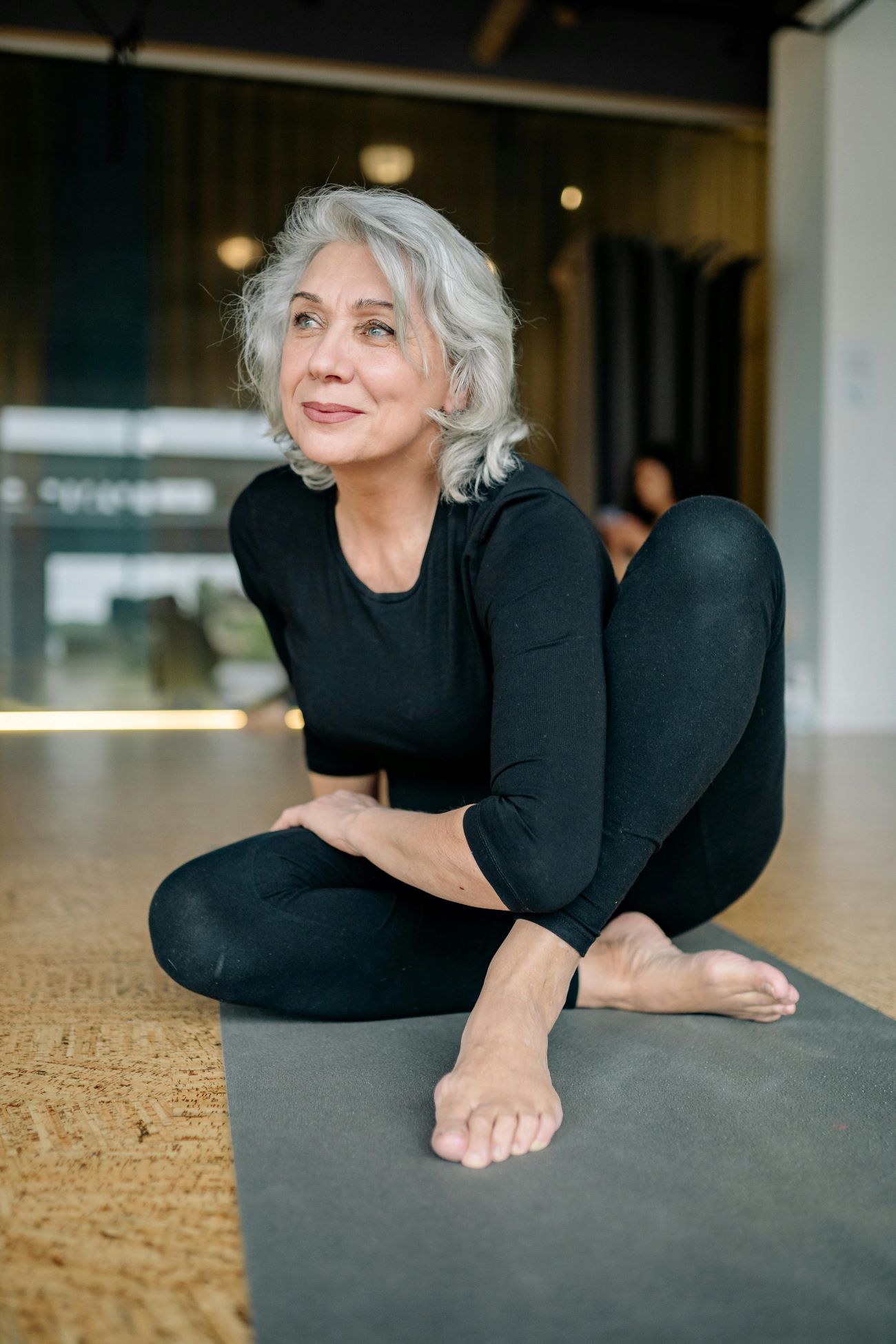
From standing to sitting tailor Start standing and sit down on the floor with your legs crossed. Then try to get back up to standing, without using your hands or other body parts. You will receive one minus point each for the following:
– Hand used as support
– Knees used as support
– Forearm used as support
– One hand on knee or thigh
– Side of the leg used as support