



Premium glass is best – but all meet the requirements. The price of spectacle lenses differs considerably between different manufacturers and optician chains. Test fakta's large test of spectacle lenses shows that the premium lenses from the manufacturers are slightly better, especially when it comes to scratch resistance, but no spectacle lenses are bad.
AV MALIN HEFVELI
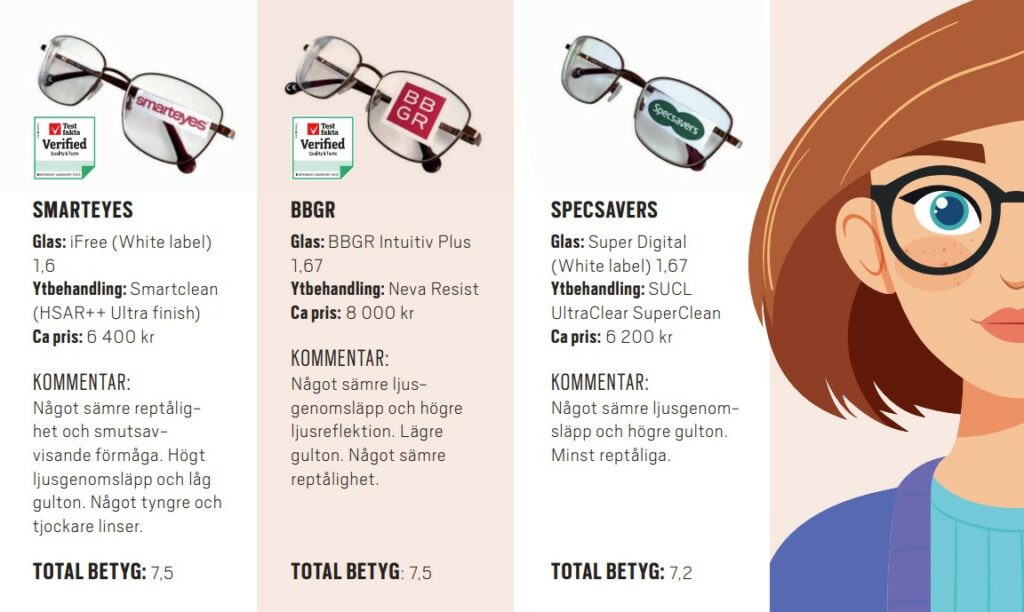
Being nearsighted comes at a cost, especially if you also start to see worse up close. A pair of progressive glasses can cost over SEK 10,000 from one of the global glass manufacturers, and then the cost of the frames is added. An accredited optical laboratory in the UK was commissioned by Testfakta to compare the optical properties and surface treatments of a number of progressive eyeglass lenses, both from the major global brands and from optician chains that sell lenses under their own names. All glasses are ordered with the same prescription for vision problems and in the same frame model. Six out of seven lenses have a refractive index of 1.67. At Smarteyes, the customer received a refractive index of 1.6 when ordering the best glasses. The most important thing about a pair of glasses is of course that they meet the optical requirements based on the prescription. The test laboratory had very little to complain about here.
“All brands are well within the limits specified in current standards. The differences that do exist are so small that they are hardly noticeable to the user,” says the responsible test engineer.
MOST CLEAR DIFFERENCE IN SCRATCH RESISTANCE
But even with perfectly ground eyeglass lenses, the visual experience can deteriorate over time, especially if the lenses are scratched. To test the lens coating protection, the lenses were subjected to controlled abrasion. The higher the force required to scratch the surface, the better the durability of the lens coating.
THIN LENSES EASIER TO WEAR
The thickness and weight of the lenses affect both comfort and appearance, and can also limit the frames you can choose from.
MATERIAL QUALITY IS DETERMINED BY LIGHT AND YELLOWNESS
The light transmission of the lens is an important measure of the optical quality of the material and affects how light changes direction and is reflected as it passes through the lens. For high-quality, untinted spectacle lenses, the light transmission should be above 95 % for excellent results. A white plastic item can turn yellow after a few years, and it is the same with spectacle lenses. For an optical lens, a yellowness index below or around 10 is a good result, and all tested lenses are around this limit.
GOOD SURFACE TREATMENTS PROVIDE LESS REFLECTIONS AND DIRT
A good anti-reflective coating reduces reflections from the lens and allows more light to pass through and reach the eye. The result is sharper and clearer vision, less eye strain and better visual acuity – especially in situations such as driving in the dark or using a computer. The test laboratory has therefore measured how much light is reflected and bounced off the lens surface. By measuring the contact angle of a drop of liquid on the glass, it is possible to determine how effectively the surface treatment repels liquid – an important property for preventing dirt and stains on the surface and facilitating cleaning. The more a drop is spread, the worse the water-repellent properties of the lens. All lenses show very good water repellency, with Zeiss at the top, while Hoya comes last, along with Rodenstock and Smarteyes.
THE MOST EXPENSIVE IS BEST – BUT CHEAP IS ALSO GOOD
Testfakta's large eyeglass test thus shows that the differences between the different lenses are not enormous. All tested lenses meet basic optical ISO requirements and have effective surface treatments. However, the comparison still reveals certain quality differences. Overall, the four premium lenses rank at the top. So for those looking for the highest quality and performance, the results point towards the established
premium manufacturers, while the low-cost options offer a more budget-friendly choice – but then the wearer has to accept some compromises, at least when it comes to scratch resistance.

GLASSES OR PLASTIC GLASSES?
Eyeglass lenses are actually a bit of a misnomer – they are not made of glass in the traditional sense, but of plastic. People started replacing glass as a material in glasses with plastic as early as the 1940s. Nowadays, several different variants are used, which make it possible to manufacture thinner and lighter lenses even for high powers. Plastic-based lenses are also safer as they do not crack as easily, and they offer better possibilities for different types of surface treatments. However, they can sometimes be slightly less scratch-resistant than real glass, and therefore different hardness treatments are often applied. Plastic-based lenses can also yellow slightly faster over time than glass, depending on the quality of the plastic and UV exposure, for example. Progressive lenses are almost always made of plastic-based polymers today
TEST TORQUE
Thickness and weight
The weight and thickness of the lenses have been measured: The thickness was measured in the middle and at the outer edge. The thinner and lighter the lenses, the higher the rating.
Light transmission
The test measures the proportion of incident light that passes through the lens and reaches the eye, known as light transmission. It is an important measurement that has a bearing on the optical quality of the lens. A high light transmission means clear and natural vision, while a lower value means poorer visibility with a
slightly darker impression.
Yellow tone index
The yellowness index is usually used as an indicator of material degradation, caused by factors such as light, heat or chemical exposure. It shows how much the color of the lens deviates from a colorless state, and thus also affects the visual experience. A low yellowness index means neutral color rendering, while a higher value gives a more yellow tone that can affect the visual experience. For an optical lens, a yellowness index below or around 10 is an acceptable result.
Reflection
To assess the anti-reflective properties of the lenses, the laboratory has also specifically measured how much light does not pass through the lens but instead bounces off the lens surface. A lower reflectance value reduces distracting reflections, improves vision quality and reduces glare in the lenses. Dirt and water repellent properties By measuring the contact angle of a drop of liquid on the glass, you can determine how effectively the surface treatment repels liquid and dirt. The lower the contact angle, the worse the water and dirt-repellent properties of the lens.
Scratch resistance
How scratch-resistant the lens surface is depends primarily on the surface treatment (hardness treatment). A scratch-resistance test measures the hardness of the surface by dragging a tungsten carbide tip over the surface.
with a certain force. The higher the force required to scratch the surface, the better the scratch resistance of the glass.
Strengths
The optical properties of the lens have been measured at a specific point to determine whether its measured power matches the prescription. The power has also been measured across the entire lens to determine how the progressivity is distributed across the surface.